ServicesWater Softeners
Water Softener Installation in Kemah, TX
Hard water leaves calcium and magnesium behind as scale inside your water heater, faucets and pipes. An ion-exchange softener pulls those minerals out on a resin bed. We measure your hardness first, size the tank from that number and explain resin, valve and salt options before any install.
How a softener works and when it makes sense
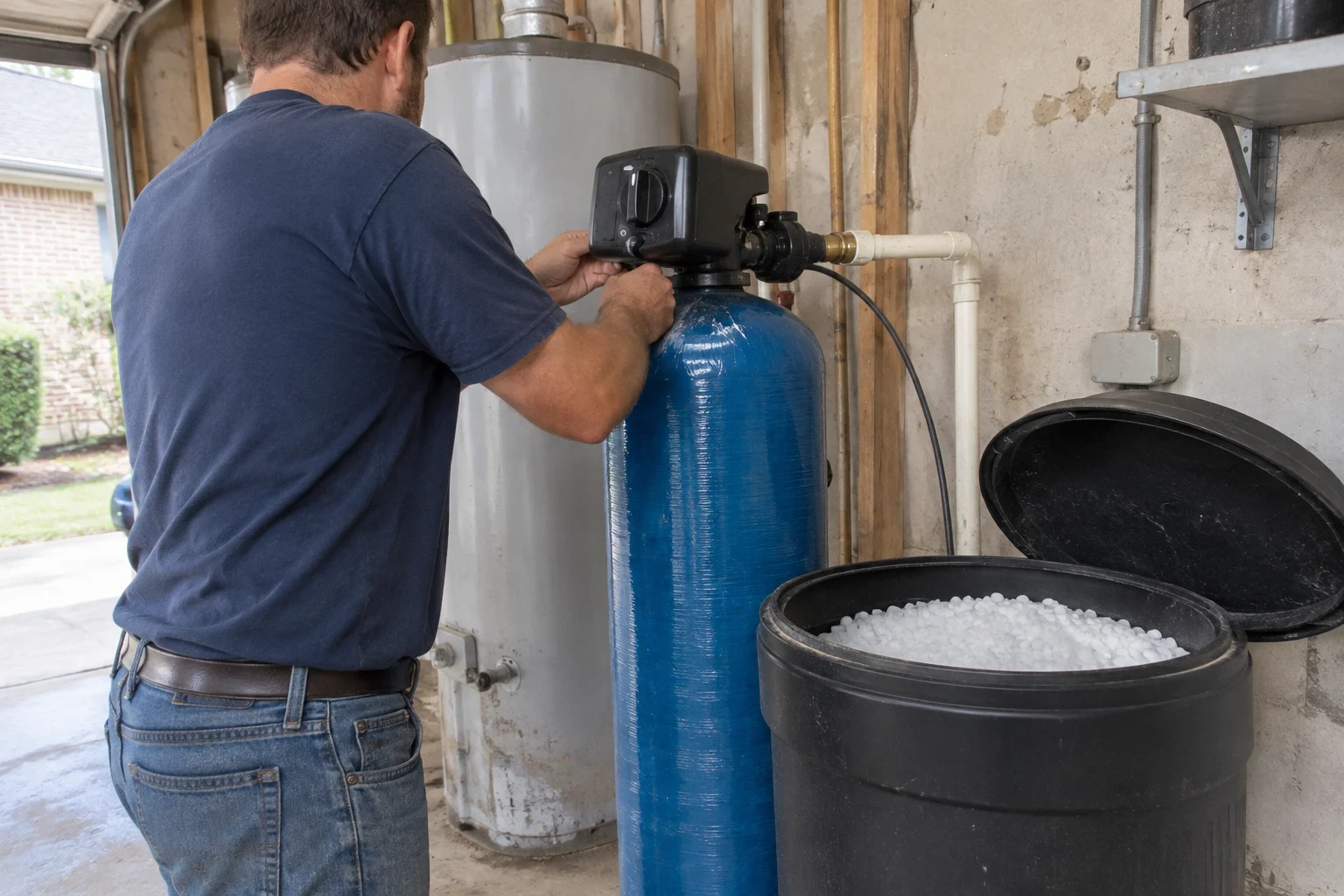
The working part of a softener is a tank of resin beads, tiny polystyrene spheres that carry a negative charge. Calcium and magnesium ions cling to them as water flows through, and the beads release sodium or potassium in exchange. Once the resin is loaded, the control valve starts regeneration, drawing brine from the salt tank to strip the hardness off the beads and rinse it out to the drain line.
Softening pays off when a test confirms meaningful hardness and you already see scale: aerators crusted shut, a water heater that pops and rumbles, haze on shower glass. If your numbers come back low, a softener only adds salt and upkeep, and we will say that plainly. Water supplies differ, so sizing starts with your results rather than a guess.
What separates one softener from another is mostly material: the resin grade, how the tank shell is built and which valve controls it. After 13 years of installing these, we find people choose better when they understand those parts instead of a brand badge.
What goes into a softener install
Hardness and iron reading
We take a hardness reading in grains per gallon plus a separate iron check. Iron coats resin beads and cuts their capacity, so both results go into the tank size and the regeneration settings.
Resin grade matched to your supply
Standard 8% crosslink resin handles most water well. On city water disinfected with chlorine or chloramine, we often suggest 10% crosslink, a tougher bead that resists the oxidation that slowly swells and cracks resin.
Demand-metered control valve
This valve tracks gallons used and regenerates only when the resin nears capacity. A timer valve regenerates on the calendar no matter how much water you ran, which wastes salt and water.
Fiberglass mineral tank and brine tank
The mineral tank is a polyethylene liner wrapped in fiberglass, so garage humidity cannot rust it. The brine tank gets a safety float that stops filling if the valve ever sticks open.
Bypass valve and drain termination
The bypass routes water around the softener during service, so the rest of your home stays supplied. We end the drain line above its receptor with an open break in the pipe, which keeps regeneration discharge from ever being pulled backward toward the tank.
Signs hard water is costing you
Chalky buildup on faucets
Calcium carbonate dries into white rings around fixtures and plugs the jets in showerheads. Vinegar dissolves it for a week or two, then it is back.
Popping from the water heater
Scale collects on the floor of a tank heater and pockets water beneath it. When that trapped water boils into steam you hear pops and rumbles, and the burner runs longer to push heat through the crust.
Cloudy spots on glassware
As droplets dry, the dissolved minerals stay put and leave a haze, even on glasses fresh from a dishwasher cycle.
Soap scum instead of suds
Calcium and magnesium react with soap to form a curd-like scum. You go through more detergent and shampoo, and towels dry stiff.
An older softener failing
Returning hardness, amber resin beads in faucet screens or standing water in the brine tank usually trace back to a worn valve, a cracked distributor tube or a salt bridge. We will tell you whether fixing it beats replacing it.
How the job runs
- 1
Start with a phone conversation
Describe the symptoms you have noticed and give us a rough idea of how much water your household uses. From there we schedule a visit to test.
- 2
Test and size
At the visit we test hardness and iron at a tap and check where the main line comes into your home. Multiplying grains of hardness by daily gallons gives the capacity target, and that sets the tank size.
- 3
Install day
With the water off, we cut a bypass and softener loop into the main line, run the drain with its air gap, place the brine tank and add salt. In most homes the water is back on by afternoon.
- 4
Program and walk-through
We enter your hardness and reserve setting on the valve, force a first regeneration and retest the output. Then we point out how to judge when the brine tank needs more pellets and which way the bypass handle turns if you ever need to isolate the unit.
What sets the price of a softener
Softener pricing follows the hardware and the work to connect it, not a flat package. Installation is free, so the number mostly reflects the equipment you choose. We go over each part of the price on the call and at the visit, so nothing shows up later.
- Capacity
- Harder water or a bigger household needs more resin, which means a larger tank and brine tank.
- Resin and valve choice
- 10% crosslink resin and a metered valve cost more up front than standard resin and a timer, and usually pay it back in resin life and salt use.
- Iron or extra treatment
- Iron in the water may call for a pre-filter or a resin cleaner feed. Pairing the softener with whole-home filtration for chlorine adds equipment.
- Plumbing at the main line
- An easy loop in a garage is quick. Rerouting a main line or adding a drain where none exists takes more time and material.
Water softener questions
Something not covered here? (281) 688-9298
Is a softener worth it if I don't see any scale?
Sometimes it is not. Water with low hardness gains little from softening, and you would still pay for salt and upkeep. We start with water testing and recommend a size only when the results justify one.
Which salt is better, sodium chloride or potassium chloride?
Sodium chloride costs less and strips hardness off the resin efficiently. Potassium chloride keeps sodium out of your water, but each bag costs more and the valve uses more of it per cycle. With either one, buy evaporated pellets or clean solar crystals, because rock salt carries insoluble dirt that turns to sludge in the brine tank.
Does softened water taste salty?
At typical hardness the sodium added during exchange is slight, and few people notice it. If you want drinking water with almost no sodium, a reverse osmosis unit under the kitchen sink takes it out along with other dissolved solids.
How do salt-free conditioners compare?
Salt-free units pass water over a template media that changes how calcium forms crystals, so less of it sticks to surfaces. The minerals stay in the water, though. They can help with mild scale, but if you want water that is actually soft, ion exchange is what removes the hardness.
What support comes with the system after install?
Your part is keeping salt in the brine tank. We provide full services after the sale, including valve checks and resin service, and every softener we install carries a lifetime warranty.
Get the right softener size for your home
Describe the scale and spotting you are dealing with, and we will schedule a hardness test and lay out the resin and valve options that fit. Installation is free, and we work in Kemah, Webster, Dickinson and the towns around them.